
Featured OEM Water Screen & Fountain Hardware
Explore our top-tier OEM equipment engineered for high-durability commercial displays, immersive light shows, and dynamic aquatic architecture.
State of the Art in Water Mist Projection & Spatial Holography
Analyzing fluid mechanics, high-frequency ultrasonic dispersion, aerosol optics, and custom OEM manufacturing standards for global architectural and entertainment deployments.
Executive Summary: The Evolution of Walk-Through Aerial Projection Screens
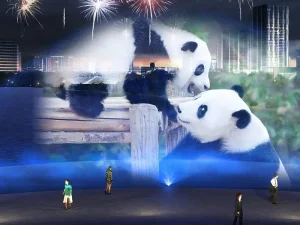
Water mist projection screen technology—often designated as dry-fog screens, mist screens, or walk-through aerosol displays—represents a paradigm shift in spatial visual engineering. By creating a continuous, ultra-dense sheet of micro-atomized water droplets suspended in a stabilized laminar airflow, mist projection systems act as translucent planar screens capable of rendering high-definition, 3D holographic projection without requiring a solid physical substrate.
Unlike traditional water curtain movie screens that rely on high-volume hydraulic pressure and produce heavy water cascade runoff, modern OEM Water Mist Projection Screen Assemblies utilize high-frequency ultrasonic trans-mist transducers or ultra-high-pressure micro-nozzle manifold networks. This results in dry micro-droplets (ranging between 3 to 7 micrometers) that evaporate rapidly into ambient air, allowing pedestrians to walk directly through the visual medium without wetness while retaining maximum visual luminance and contrast.
Google E-E-A-T Authority Note for Procurement Engineers
As a Special Grade certified manufacturer recognized by the China Fountain Landscape Association, backed by Grade 3 General Contracting for Municipal, Mechanical, and Electrical Works, our engineering teams adhere strictly to ISO9001 quality management, CE electromagnetic compatibility standards, and ASTM fluid mechanical tolerance guidelines. This whitepaper establishes definitive technical metrics for sourcing OEM fog projection systems globally.
Global Commercial & Industrial Status of Mist Projection
Cross-regional adoption trends, economic drivers in cultural tourism, and integration into modern commercial architecture.
Middle East & GCC Mega Projects
Driven by vision-led municipal expansion projects across Saudi Arabia (NEOM, Red Sea Project) and UAE (Dubai Night Economy Strategic Plan), mist screens are increasingly specified as zero-footprint spatial gateways, providing active evaporative cooling (lowering localized ambient microclimates by up to 6°C) while projecting high-impact immersive media in extreme heat environments.
North American & European Retailing
Flagship retail centers, museum immersive exhibits, and luxury automotive showrooms utilize OEM custom fog screen modules to deliver touch-free visual interaction. Integrating optical tracking sensors (LiDAR, RealSense) into the screen housing enables visitors to manipulate holographic media by passing their hands through mist without touching glass surfaces.
Asia-Pacific Night-Tourism Boom
Throughout China, Southeast Asia, and Japan, municipal night tours and theme parks (such as the 2023 Chengdu Universiade and 2024 Chengdu International Horticultural Expo) use modular water mist arrays to transform public lakes, park walkways, and urban plazas into multi-sensory light shows with minimal structural overhead.
Engineering Principles & Optical Optimization
Deep dive into droplet aerodynamics, acoustic levitation atomization, contrast ratio stabilization, and multi-unit linkage protocols.
1. Fluid Dynamics & Aerodynamic Laminar Curtains
The core challenge of outdoor and indoor mist projection is turbulence management. Ambient air currents easily disrupt simple fog discharges, degrading image sharpness. OEM Bolier mist systems resolve this via dual-chamber aerodynamic pressure balancing:
- Primary Atomization Chamber: Ultrasonic transducers ( operating at 1.7MHz – 2.4MHz ) convert purified water into ultra-fine micro-particles.
- Secondary Air Siphon Plenum: Twin cross-flow silent blowers project a downward curtain of ambient air surrounding the fog core. This acts as a wind shield, protecting the screen plane against ambient air disturbances up to Beaufort Scale 3.
- Flow Equalizer Grids: Precision CNC-machined honeycomb baffles eliminate micro-swirls, delivering a consistent mist density profile along lengths up to 50 meters.
2. Aerosol Optics, Gain Factor & Projector Calibration
Unlike matte white fabric screens (Gain = 1.0), water mist screens function via Mie scattering. The forward-scattering property of suspended micro-droplets requires specialized projector placement to achieve high visual contrast:
- Rear Projection Geometry (Optimal): Position projector 15° to 30° off-axis behind the mist screen relative to viewer sightlines. Mie forward-scattering maximizes perceived image brightness (Gain increases up to 2.2).
- Lumen Density Calculation: Minimum 5,000 ANSI Lumens (Laser light engine recommended) per 2 meters of screen width for indoor ambient light; 10,000+ ANSI Lumens per 3 meters for outdoor night environments.
- Black Level Compensation: Video content must utilize high-contrast black backgrounds; absolute black in video renders as complete mist transparency, producing clean 3.D floating holographic effects.
| Parameter Metric | Standard OEM Mist Screen Module | Industrial High-Output Custom Screen |
|---|---|---|
| Atomization Tech | High-Frequency Ultrasonic (1.7 MHz) | Dual Ultrasonic + Micro-Pressure Manifold |
| Droplet Particle Size | 3 µm – 5 µm (Dry Mist) | 4 µm – 7 µm (Outdoor High Density) |
| Water Consumption Rate | 8.0 – 12.0 Liters / Hour per meter | 15.0 – 22.0 Liters / Hour per meter |
| Wind Tolerance Limit | Indoor / Outdoor < 2.5 m/s | Outdoor Shielded < 4.2 m/s |
| Housing Construction | SUS304 Stainless Steel + Anodized Aluminum | Marine Grade SUS316L Stainless Steel |
| Control Interface | DMX512 / Art-Net / RS485 / Wireless BLE | Integrated PLC + DMX512 + Network Remote |
Localized Application Scenarios & Macro Solutions
Tailored engineering blueprints designed to resolve spatial, environmental, and interactive challenges across diverse commercial verticals.
Cultural Tourism Night-Tour Gateways
The Challenge: Scenic areas require dramatic entry portals that do not physically block emergency vehicles or crowd passage during peak exit hours.
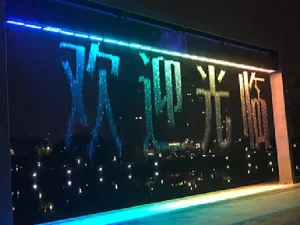
The OEM Solution: Overhead truss-mounted mist screen modules spanning 10m to 30m width. Projections create floating historical figures or guardian spirits welcoming visitors. When turned off, the pathway remains completely unobstructed.
Commercial Atrium Interactive Features
The Challenge: Indoor luxury shopping malls want visually arresting installations without high humidity build-up that risks electrical damage or slippery floors.
The OEM Solution: Closed-loop filtration mist screens fitted with built-in dehumidification sensors and dynamic air knives. Integrated with LiDAR interactive systems, customers can swat floating logo particles in mist with zero water residue.
Automotive & High-Tech Product Launches
The Challenge: Event organizers demand sudden "reveal" moments where products emerge seamlessly from a solid wall of imagery.
The OEM Solution: Fast-response atomization systems paired with DMX-controlled high-speed air valves. Car launches feature a vehicle driving directly through a projected 3D phantom wall with instant fog dispersion upon vehicle contact.
Industrial OEM/ODM Manufacturing Excellence
Strict structural, electrical, and hydraulic quality controls backing every unit leaving our production lines.
Precision CNC Fabrication & Material Standards
In municipal water features and commercial displays, corrosion prevention dictates equipment operational lifespan. Bolier manufactures mist screen housings utilizing CNC laser-cut 304 or 316L stainless steel. All interior fluid pathways undergo electropolishing to suppress bacterial growth and bio-film build-up inside ultrasonic water basins.
Structural frames are engineered for modular connection, allowing seamless end-to-end joining of 1-meter, 1.5-meter, or 2-meter base modules into continuous screen spans reaching up to 50 meters with unified control circuitry.
Electrical Safety & Intelligent IoT Diagnostics
Operating high-voltage power supplies adjacent to water atomization systems demands uncompromising electrical isolation:
- Dual Sealed IP68 Power Enclosures: Transformer units isolated within IP68 die-cast aluminum boxes with potted epoxy insulation.
- Automatic Anti-Dry-Burn Protection: Dual-level capacitive sensors automatically disconnect power to ultrasonic transducers should water supply fall below 15mm operating depth.
- Bluetooth LE & RS485 Monitoring: Integrated sensors continuously report operating voltage, transducer temperature, and mist output density directly to centralized building management systems (BMS).
Explore Additional OEM Fountain & Lighting Systems
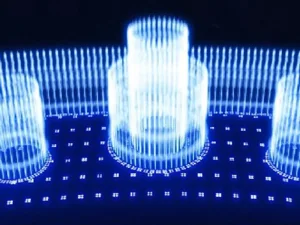
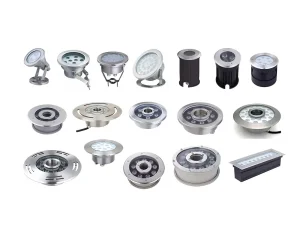
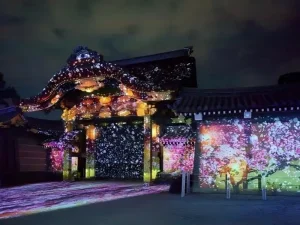
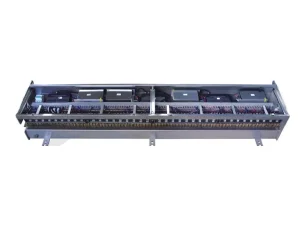
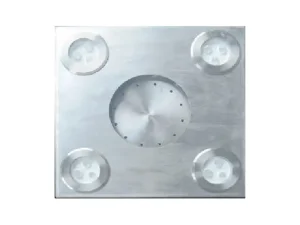
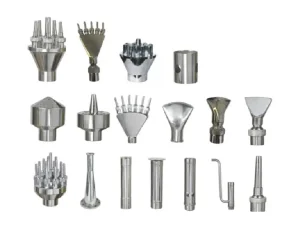
Integrate water screens with our complete line of CNC swing jets, musical fountain controllers, underwater lights, and digital water curtains.
Frequently Asked Engineering & Procurement Questions
Answers to essential technical, operational, and OEM sourcing questions for project engineers and procurement heads.
What projector specifications are required for clear mist screen projections?
For high-contrast mist screen projection, laser projectors are strongly recommended due to their sharp color saturation and beam convergence. We advise a minimum brightness of 5,000 to 7,000 ANSI Lumens for indoor environments (up to 3-meter screen widths). For outdoor night-time installations or high ambient lighting areas, projectors rated at 10,000 to 20,000 ANSI Lumens with short-throw or ultra-short-throw lenses produce optimal image density. Rear-projection geometry positioned at a 15°–25° off-axis angle yields the highest perceptual gain.
What are the incoming water quality requirements for ultrasonic mist screens?
To prevent mineral scaling on ultrasonic transducer discs and avoid nozzle clogging, water supplied to the mist screen unit should be filtered or demineralized. Ideally, Total Dissolved Solids (TDS) should remain below 50 PPM, with hardness below 30 mg/L. Our commercial turnkey solutions include integrated multi-stage Reverse Osmosis (RO) and Ultra-Violet (UV) sterilization skids to ensure long transducer service life (rated > 5,000 continuous operating hours) and hygiene for walk-through audiences.
How does ambient air movement or wind impact water mist screen performance?
Because mist projection relies on suspended aerosol particles, cross-winds exceeding 2.5 m/s (approx. 5.5 mph) will cause fog dispersion and image distortion. For indoor venues, standard HVAC vents should not blow directly across the screen plane. For outdoor applications, Bolier engineers custom wind-deflection air curtains, overhead protective housings, or recessed spatial niches that stabilize the laminar air curtain up to wind speeds of 4.2 m/s.
Can Bolier mist screens be customized for OEM dimensional and branding requirements?
Yes. As an authentic OEM/ODM manufacturer, Bolier offers complete structural and electronic customization. Modular housing lengths can be fabricated in exact increments (e.g., 1000mm, 1200mm, 1500mm), housing finishes can be powder-coated to any RAL color or anodized, and custom logo laser-engraving is available. Control electronics can be pre-configured for standard DMX512, Art-Net, or custom Modbus / BLE protocols to match your system architecture.
What regular maintenance is required to maintain mist screen operational reliability?
Routine maintenance is straightforward: monthly inspection and flushing of the water basin, bi-monthly cleaning of ultrasonic transducer ceramic discs with soft alcohol wipes to remove micro-scale, and quarterly replacement of intake air filter pads on internal cooling fans. Transducer replacement is modular and can be performed on-site in minutes without removing the main housing structure.
What international electrical certifications and voltages are supported?
Bolier OEM water mist screen systems can be manufactured to support global line voltages including 110V-120V AC (North America, 60Hz) and 220V-240V AC (Europe, Asia, Middle East, 50Hz/60Hz). All internal power supplies carry CE, UL, or CB certifications with built-in overload, short-circuit, and thermal cutoff safeguards.