High-Performance Show Systems & Digital Actuation
Explore our flagship OEM hardware engineered for flawless fluid dynamics, extreme hydrodynamic sync, and municipal architectural resilience.



Global Commercial & Industrial Status of Fountain Plumbing Design
A comprehensive technical overview of fluid dynamic engineering, mechanical piping standards, and modern architectural waterscape infrastructure.
Hydraulic Mechanics & Head Loss Optimization
Modern commercial water displays have evolved far beyond decorative aeration. Today’s architectural installations demand rigorous hydraulic engineering, where pressure drop (friction loss) through manifolds, bends, and valves directly dictates dynamic jet consistency. Standardized municipal fountain plumbing design now utilizes empirical Darcy-Weisbach and Hazen-Williams equations to size suction, header, and discharge pipes, preventing severe kinetic attenuation across complex multi-nozzle geometries.
- Reynolds number computation across varied flow regimes
- Minimization of secondary vortical eddy losses
- Uniform head distribution across parallel manifolds
Metallurgical Selection & Anti-Corrosion Standards
Industrial fountain systems operate in demanding submerged and semi-submerged environments with continuous chlorine, bromine, or ozone treatment. OEM plumbing design prioritizes austenitic stainless steels (AISI 304 and marine-grade AISI 316L) as well as Duplex 2205 alloys for coastal or high-salinity applications. Advanced passivation, full-penetration orbital TIG welding, and pickling treatments ensure pipeline longevity, avoiding crevice corrosion and stress corrosion cracking (SCC).
- AISI 316L stainless steel for sub-surface chemical stability
- Automated orbital TIG welding eliminating weld seam oxidation
- Dielectric isolation flanges to suppress galvanic currents
Transient Pressure & Water Hammer Mitigation
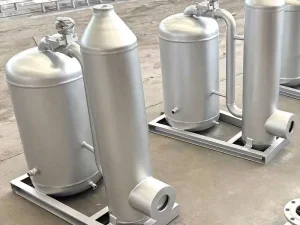
Rapid switching of high-frequency solenoid valves and dynamic CNC swing devices causes sudden fluid deceleration, creating destructive pressure spikes known as hydraulic transient surges (water hammer). Factory-engineered plumbing integrates ASME-rated surge vessels, nitrogen bladder accumulators, pressure-relief bypass circuits, and elastic elastomer dampers. This protects pump impellers, flange gaskets, and digital nozzle seals from catastrophic rupture.
- Surge tank dampening calculated via Joukowsky's equation
- Soft-closing check valves and high-speed bypass manifolds
- Pressure sensors integrated directly with safety interlocks
Emerging Trends & Technical Roadmap in Fountain Piping
How digital twins, artificial intelligence, and modular off-site fabrication are revolutionizing commercial plumbing engineering.
Computational Fluid Dynamics (CFD) Digital Twins
The days of on-site trial-and-error plumbing adjustments are obsolete. High-end OEM manufacturing now deploys ANSYS Fluent and OpenFOAM simulation pipelines to create 3D virtual flow models prior to fabrication. Engineers simulate non-Newtonian multiphase boundary conditions, optimizing internal pipe diverters and nozzle plenum chambers to achieve laminar exit trajectories without turbulence or spray drift.
IoT-Enabled Smart Pressure Telemetry
Next-generation fountain plumbing networks incorporate inline piezoresistive pressure transducers, ultrasonic flowmeters, and thermal sensors directly wired to edge-computing PLC cabinets. This allows continuous real-time verification of pump curve efficiencies, automated detection of clogged strainers or nozzle orifices, and cloud-based predictive maintenance before mechanical cavitation degrades hardware.
Pre-Fabricated Skid-Mounted Manifold Blocks
To slash expensive on-site installation timelines and eliminate field welding errors, modern projects rely on factory-assembled modular skid frames. All stainless steel headers, VFD submersible pumps, check valves, pneumatic actuators, and balancing valves are skid-mounted, pre-wired, hydrostatically pressure-tested to 1.6 MPa, and passivated under clean factory conditions before international shipping.
| Plumbing Dimension | Legacy Fountain Construction (1990-2010) | Current Advanced OEM Standard (2020-2025) | Next-Gen AI & Smart Water Roadmap (2026+) |
|---|---|---|---|
| Manifold Material | Carbon steel or schedule 40 PVC | AISI 304 / 316L Stainless Steel with pickling | Duplex 2205 / Nano-coated anti-biofouling alloys |
| Hydraulic Balancing | Manual ball valves & field guesswork | CFD-modeled symmetrical manifolds & dynamic balancing | Self-tuning motorized servo-plenum valves with IoT closed-loop feedback |
| Surge Protection | Basic air chambers (often waterlogged) | ASME-certified bladder expansion tanks + bypass relief | Active electronic frequency modulation & predictive micro-bypass damping |
| Filtration Plumbing | Coarse basket strainers only | Multi-grade sand filters + automatic backwash + 200μm inline traps | Automated centrifugal separator + UV/Ozone secondary loop sanitization |
Localized Application Scenarios & Mechanical Adaptations
How custom plumbing design solves environmental, architectural, and operational constraints across demanding project typologies.
Dry Deck Plazas (Interactive In-Ground Fountains)
Dry deck installations require recessed sub-surface trenches or modular stainless steel vaults beneath pedestrian-rated granite pavers. Plumbing design mandates low-profile, rapid-drainage collectors to prevent standing water hazards. Specialized siphon-break drainage rings and secondary return gutters prevent pedestrian contaminants from entering main pump suction lines, maintaining pristine water clarity and public safety compliance.
Deep Natural Lakes & Floating Marine Platforms
For large-scale ecological lakes or reservoirs with wide water level fluctuations (1 to 5 meters), rigid plumbing is unfeasible. We engineer buoyant HDPE or 316L pontoon platforms interconnected via heavy-duty stainless-steel-braided EPDM flexible expansion loops. Submersible pump arrays sit inside hydrodynamic flow-inducer sleeves with automatic bio-fouling backflush screen systems to prevent aquatic weed suction.
Extreme Sub-Zero Climates & Freeze Protection
Fountains in continental or alpine climates (e.g., Central Asia, Northern China, Eastern Europe) face severe freeze-thaw damage. Plumbing design incorporates continuous positive-slope drainage pipes (minimum 1.5% fall) with automated pneumatic blow-down valves. During seasonal shutdowns, compressed nitrogen purges residual moisture, while integrated trace heating cables inside exposed manifolds protect against unseasonal cold snaps.
Macro Industry Solutions: Seamless MEP Integration
Ensuring complete synergy between architectural vision, structural engineering, and municipal building services.
BIM (Building Information Modeling) & Clash Detection
Fountain plumbing cannot exist in an engineering silo. Bolier delivers complete Autodesk Revit and Navisworks BIM models with parametric LOD 400 detail. This allows mechanical, electrical, and structural engineers to detect clashes with civil reinforcement rebar, HVAC conduits, and electrical trenches long before civil concrete pouring commences, saving tens of thousands of dollars in site rework.
VFD Hydraulic Response Synchronization
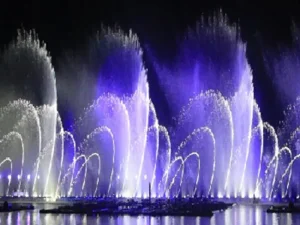
For choreographed musical fountains and high-speed CNC robotic jets, water columns must rise and fall in millisecond alignment with acoustic cues. Pipe volume, water inertia, and nozzle discharge coefficients must be balanced. Our plumbing design minimizes downstream piping length between pump discharge and nozzle, ensuring near-instantaneous pressure response under variable frequency drive (VFD) ramps.
Closed-Loop Water Quality & Sanitization Architecture
Public interaction fountains require strict adherence to international recreational water safety guidelines (e.g., CDC Model Aquatic Health Code). Bolier's plumbing plans include automated secondary bypass loops featuring high-rate sand filtration, automated proportional sodium hypochlorite/pH dosing systems, UV germicidal irradiation, and active skimmer weirs that remove surface debris before it damages fine nozzle orifices.
Frequently Asked Questions on Fountain Plumbing Design
Direct technical answers for landscape architects, MEP consultants, and general civil contractors.
How do engineers calculate pipe diameter and prevent flow starvation across a multi-nozzle manifold?
What is the difference between AISI 304 and AISI 316L stainless steel in fountain plumbing?
How is hydraulic water hammer eliminated during high-speed musical fountain choreography?
Can Bolier pre-fabricate skid-mounted plumbing systems that comply with local MEP codes overseas?
How are suction vortex formation and pump cavitation prevented in shallow basin designs?
Precision Submersible Pumps, Actuators & Ancillary Devices
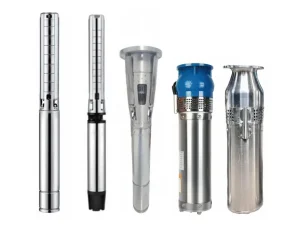
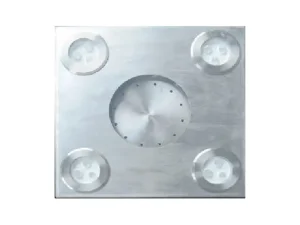
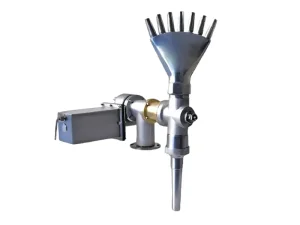
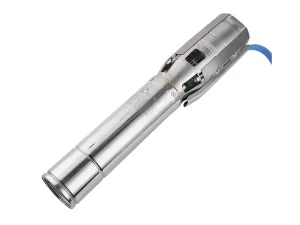
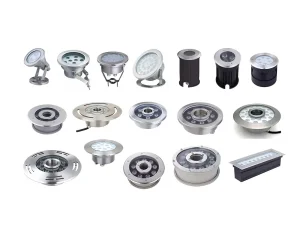
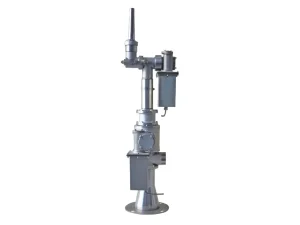
Explore our heavy-duty submersible electric pumps, CNC multi-axis swing mechanisms, and professional illumination hardware engineered for decades of continuous operation.