Flagship Engineered Waterscape Systems
Explore our foundational hydraulic actuators, specialized fountain nozzles, and high-frequency submersible pump units configured for international engineering standards.
Global Enterprise Sourcing & Macro-Waterscape Landscape
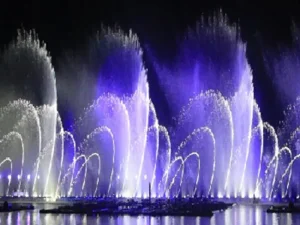
In modern urban sociology and architectural landscape engineering, aquatic displays have evolved from static ornamental fountains into multi-sensory civic assets driving urban night economies, mega-resort footfall, and cultural tourism capitalization.
Corporate real estate developers, municipal planning authorities, EPC contractors, and international theme park operators face increasing operational complexities. Modern aquatic installations require multidisciplinary synthesis across computational fluid dynamics (CFD), corrosion-resistant metallurgy, high-voltage underwater electrical safety, and sub-millisecond protocol synchronization (DMX-RDM, Art-Net, sACN, and industrial Modbus).
Night-Time Economic Drivers
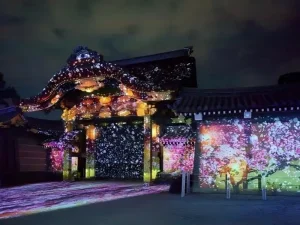
Global tourism research confirms signature evening water and light spectacles expand regional retail and dining dwell-times by 42% to 68%. Municipalities utilize programmed aquatic shows to transform waterfront promenades into vibrant revenue-generating cultural epicenters.
Harsh Environment Resilience
Procurement teams across GCC arid zones, coastal Southeast Asia, and sub-zero Central Asia require rigorous climatic hardening: AISI 316L/904L stainless steel housings, IP68 hermetic submersibles, and closed-loop heating trace cables preventing thermal fracture.
Lifecycle TCO Optimization
Traditional procurement focused on initial capex; Tier-1 global tenders now mandate comprehensive Total Cost of Ownership evaluations. Variable frequency servo pumping, solid-state LED arrays, and automated backwash filtration drastically curb continuous power and water waste.
Established Benchmark
Over 18 years of uninterrupted factory production & R&D
Invention Patents
Proprietary mechatronics, swing mechanisms & valve systems
Original Products
Full-stack in-house manufacturing for turnkey precision
Factory Acceptance
Wet-tested hydraulic calibration prior to global export
Enterprise Technical Standard & Procurement Matrix
Architectural and engineering firms require verified mechanical, hydrodynamic, and electrical telemetry parameters to ensure seamless BIM integration and long-term operating safety.
| Subsystem Domain | Technical Parameters & Operating Standard | Material / Construction Standard | Control / Interface Protocol | Compliance / Safety Certification |
|---|---|---|---|---|
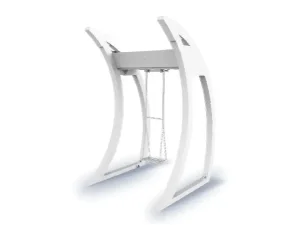
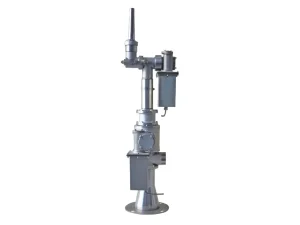
| CNC Multi-Axis Swing Units | 0-180° bidirectional rotation; 120 cycles/min; 0.05° positioning repeatability | AISI 316L Marine Stainless Steel; Ceramic Hybrid Bearings | DMX512-A / RDM / CAN-bus closed-loop feedback | IP68 Hermetic Seal |
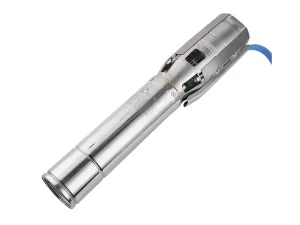
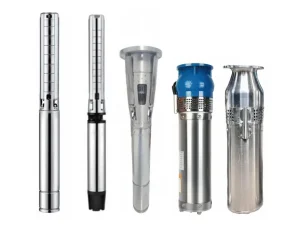
| High-Head Submersible Pumps | Flow: 15-350 m³/h; Head: 8-120m; Variable vector frequency 10-65Hz | Precision cast SS304/SS316; Silicon carbide mechanical seals | RS-485 Modbus-RTU / Inverter direct bus integration | CE / IEC 60335-2-41 |
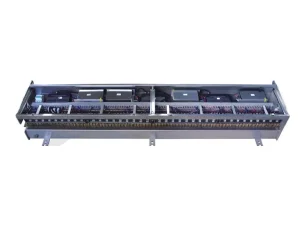
| Digital Droplet Water Curtains | Response time: <1.8ms; Droplet frequency: 200 Hz; Pixel density: 32-64/m | Anodized extruded aeronautical 6063-T6 aluminum body; Brass micro-valves | Art-Net / Ethernet TCP/IP / High-speed custom serial matrix | Low-Voltage SELV |
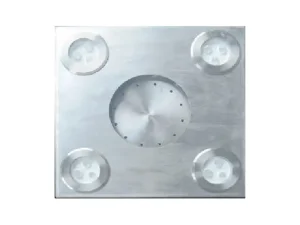
| Submersible DMX-LED Arrays | Cree/Lumileds RGBW; 3000K-6500K dynamic; 50,000 hrs L70; 12/24V DC | Die-cast 316L casing; 8mm thermal shock resistant tempered glass | DMX512 / RDM remote addressing & temperature sensing | IP68 Immersion Class |
| Specialty Flame & Gas Explosion | Flame height: 3-18m; Multi-stage fuel accumulator; Instant BLE telemetry | Explosion-proof stainless alloy casing; Automated pilot ignition | Industrial Safety PLC / Hardwired emergency stop matrix | ATEX / EX-Zone 1 Rated |
Hydraulic Cavitation Protection
Custom-contoured nozzle throats are precision-machined via 5-axis CNC to eliminate boundary layer micro-turbulence, preventing acoustic cavitation and preserving stream cohesion at heights exceeding 80 meters.
Dynamic Thermal Dissipation
Our underwater optical modules integrate direct-to-water thermal heat exchangers, allowing high-flux lumen output while maintaining operating junction temperatures well below silicon degradation thresholds.
Modular Quick-Disconnect
All underwater actuators and sensor arrays feature marine-grade IP68 IP69K stainless quick-disconnect couplers, slashing on-site maintenance cycles from hours to under 15 minutes per device.
Redundant Dual Bus Ring
Control architecture supports fault-tolerant ring topologies. If an underwater signal cable is severed by debris, the network automatically self-heals in <10ms, eliminating show-stopping failures.
Technological Roadmap: The Future of Intelligent Hydro-Displays
Water feature engineering is transitioning rapidly toward cyber-physical convergence, combining predictive computational mechanics, real-time audio machine learning, and closed-loop ecological water filtration.
AI Predictive Hydromorphic Maintenance
Deployment of edge-computing IoT vibration and dielectric sensors inside submersible pump windings and CNC gearboxes, predicting seal wear or mechanical misalignment 300 operating hours before physical failure occurs.
Algorithmic Music Choreography
Moving beyond manual timeline programming. Deep-learning frequency extraction algorithms convert raw audio spectral density into 3D dynamic fluid motion curves, reducing complex fountain show production cycles by 70%.
Holographic Aerodynamic Water Projection
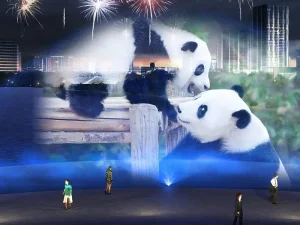
Ultra-dense, micro-droplet laminar water curtains paired with 40,000-lumen laser projectors deliver high-definition volumetric visuals floating above natural water bodies without requiring solid structural backdrops.
Net-Zero Closed-Loop Ecosphere
Integration of biological nanofiltration, solar-assisted kinetic pumps, and graywater purification systems that allow monumental fountains to function as municipal aeration ecosystems that purify urban lakes.
Global Project Execution & Localized Regulatory Compliance
Delivering high-profile water feature projects requires navigating diverse structural building codes, local electrical grid variances, seismic criteria, and rigorous environmental discharge parameters across multiple continents.
Grid Voltage & Frequency Adaptability
All factory-assembled control cabinets, variable frequency drives (VFDs), and pump motors are configured to exact regional parameters: North American 480V 60Hz, European/Asian 380V-415V 50Hz, or specialized maritime 440V auxiliary supplies.
Public Safety & Low-Voltage Isolation
For dry-deck plaza fountains where children directly touch the water, systems utilize galvanic low-voltage isolation (12V/24V DC for LED and actuators), residual current circuit breakers with 10mA trip sensitivity, and non-slip flush bronze nozzles.
Global Field Engineering Dispatch
Bolier provides end-to-end on-site engineering supervision: mechanical anchoring, hydraulic manifold balancing, DMX network calibration, and local personnel operations training across Europe, the Middle East, Central Asia, and the Americas.
Frequently Asked Engineering & Procurement Questions
In-depth technical answers addressing hydraulic friction losses, marine corrosion prevention, timeline planning, and turnkey equipment integration.
For high-salinity and marine projects, our engineering team replaces standard AISI 304 components with passivated AISI 316L or 904L austenitic stainless steel. For extreme chloride environments, we utilize titanium alloy nozzle inserts and non-metallic PTFE internal guides. Submersible pumps are fitted with specialized silicon carbide mechanical seals and sacrificial zinc anode plates positioned across structural frames to eliminate electrochemical corrosion.
Our proprietary show controllers process audio timecode synchronization via SMPTE (LTC) and Art-Net/sACN protocols with an end-to-end command latency of under 5 milliseconds. Hydraulic jet reaction times are pre-compensated in our show choreography software: the system mathematically accounts for the physical flight time of water columns based on nozzle diameter and operating head pressure, ensuring water apex hits precisely on musical beats.
Yes. We design and manufacture heavy-duty pontoon platforms fabricated from structural marine-grade HDPE or hot-dip galvanized and epoxy-coated steel. These platforms utilize self-adjusting sliding pile guide collars or elastic tension mooring systems connected to underwater counterweights. This allows the complete musical fountain and laser projection system to maintain level orientation and stable visual trim across seasonal water level fluctuations up to 12 meters.
We supply a comprehensive engineering documentation package, including full 3D BIM (Revit/Navisworks) models, hydraulic single-line schematics, computational fluid dynamics (CFD) spray pattern simulations, structural anchor load calculations (accounting for dynamic water reaction thrust and local wind shear forces), single-line electrical schematics, VFD heat dissipation calculations, and detailed O&M manuals with spare-part breakdown codes.
For cold-climate regions (such as northern China, Canada, or Central Asia), systems are engineered with automated purge valves that completely drain exposed piping manifolds into subterranean surge tanks via gravity when the system powers down. Submersible floating platforms can be fitted with pneumatic submerge-on-demand ballast tanks that lower the entire equipment array below the frozen surface layer during winter months.
Specialized Multimedia & Dynamic Projection Units
High-power water screen projection equipment, digital graphic curtains, and intelligent fire-and-water combination modules engineered for stadium-grade night shows and landmark installations.