
China Top Water Fountain Pump Manufacturers for Global Buyers
Choosing a fountain pump is a practical engineering decision, not just a search for the lowest quotation. Buyers must match flow rate, lift height, operating hours, and water conditions to the fountain’s design. A pump that looks adequate on a product sheet may produce weak spray once tubing, filters, and elevation add resistance. Small details matter.
The International Energy Agency’s 2011 report, Energy-Efficiency Policy Opportunities for Electric Motor-Driven Systems, estimates that motor-driven systems use about 46% of global electricity. Pumps are one part of that group, so efficient selection and operation deserve attention—even in decorative water features. For buyers comparing China-based manufacturers, this guide considers specifications, materials, manufacturing capability, customization, and communication alongside price. Look for clear performance curves, documented testing, suitable seals, and practical guidance on installation and maintenance. Ask how the stated flow changes at your required lift; a headline capacity alone is not enough. That is not enough.
Supplier claims also need context. Certifications, warranty terms, and sample testing should be checked against the intended market and application, rather than accepted as automatic proof of performance. Real installations vary, and published figures cannot replace a properly matched system. This article explores how to assess Water Pumps For Water Fountains and compare manufacturers with a more informed eye. Some differences are subtle. They can still matter.
Understanding Water Fountain Pumps and Their Main Applications
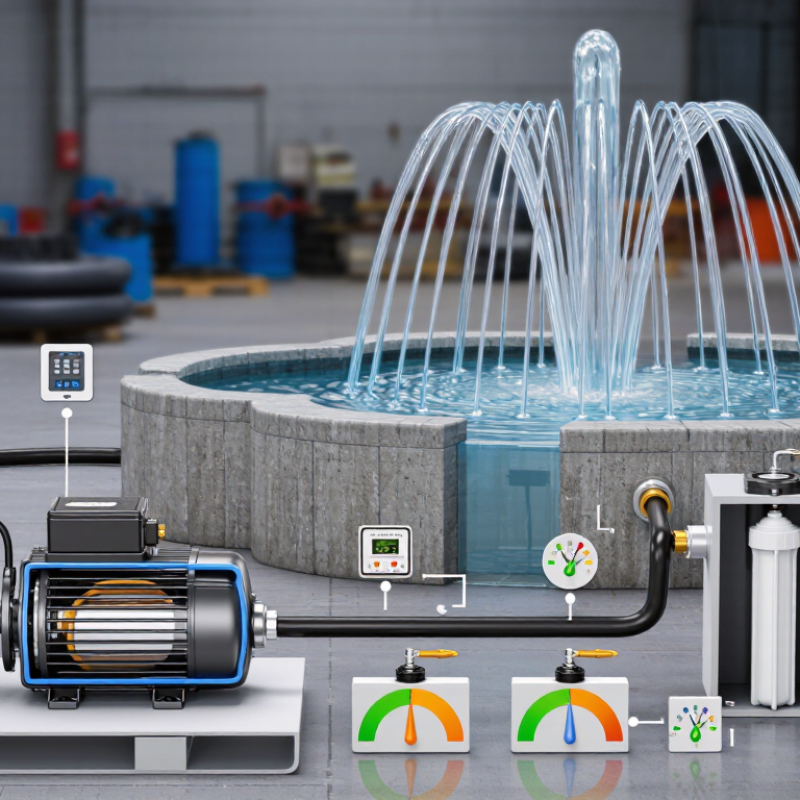
Water fountain pumps circulate water from a basin through nozzles, tiers, or sculptural channels. Their job is more than moving water: steady flow helps maintain the fountain’s visual pattern and supports oxygen exchange in ponds. Small details matter. A pump’s flow rate should match the fountain design, while its maximum head must account for the vertical lift and pipe resistance. A unit that looks powerful on paper may deliver less water once installed.
Applications range from compact indoor tabletop fountains to garden ponds and large public displays. Indoor models often need quiet operation and a small footprint; outdoor installations face leaves, grit, temperature changes, and longer operating hours. Check whether the intake can handle likely debris, and make sure the pump is accessible for cleaning. That is not always obvious. In practice, a clogged intake can reduce the spray before the pump itself shows any fault. Buyers should compare flow at the required height, energy use, outlet size, and maintenance needs—not just the advertised maximum flow. I would also leave room for adjustment: the first nozzle choice may look different once water meets the basin.
| Pump Type | Installation and Operating Principle | Common Fountain Applications | Key Selection Considerations | Typical Advantages and Limitations |
|---|---|---|---|---|
| Submersible centrifugal pump | Installed underwater in a pond, basin, or reservoir. An impeller moves water through the pump outlet. | Garden ponds, small and medium decorative fountains, water features, and some pond circulation systems. | Check the required flow and vertical lift, outlet size, water depth, debris exposure, and whether the unit is rated for continuous operation. | Compact and generally straightforward to install. The pump is less accessible for servicing and must remain within its specified operating conditions. |
| External centrifugal pump | Installed outside the water and connected to the feature with suction and discharge piping. | Large basins, commercial displays, and installations where pumps need to be accessible for inspection or maintenance. | Consider suction-pipe layout, priming requirements, pipe losses, noise, weather protection, and safe access for maintenance. | Convenient to inspect and service. Installation typically requires more space and careful plumbing than a submersible arrangement. |
| Variable-speed pump | A pump with adjustable output, commonly controlled by an integrated controller or compatible external control. | Features that need adjustable jet height, changing display patterns, or reduced flow during quieter operating periods. | Confirm control compatibility, operating range, required flow at the chosen setting, and whether the fountain nozzle performs well at variable flow. | Allows more control over the display and water movement. Controls and operating instructions add complexity compared with a fixed-speed pump. |
| Brushless DC pump | Uses an electronically commutated motor; some models can run from a compatible DC supply or controller. | Small decorative fountains, pond features, and installations where low-voltage power or adjustable operation is desired. | Verify the required power supply, controller, cable length, duty rating, and whether the pump is designed for the intended water conditions. | Can offer efficient, controllable operation in suitable applications. Performance depends on the matched power supply and model specifications. |
| Solar-powered fountain pump | Powered by a photovoltaic panel, either directly or through a system that may include a battery and controller. | Small garden features, birdbaths, and remote locations where grid power is unavailable or difficult to install. | Assess sunlight exposure, panel placement, seasonal conditions, storage or battery requirements, and expected operation during cloudy periods. | Can reduce reliance on grid electricity. Output may vary with available sunlight, and battery-backed operation depends on system capacity. |
| Magnetically coupled pump | Transfers rotation through a magnetic coupling, avoiding a conventional shaft seal between the motor and pump chamber. | Small water features and applications where limiting leakage paths is important, subject to the pump's rated flow and materials. | Check liquid compatibility, solids tolerance, temperature limits, installation orientation, and the manufacturer's operating instructions. | The coupling can avoid a traditional rotating shaft seal. It is not suitable for every fluid or duty; specifications should be checked for each model. |
| Selection note: Match the pump curve to the required flow at the system's total dynamic head, including elevation and pipe or fitting losses. Confirm voltage, materials, water conditions, continuous-duty rating, and applicable electrical safety requirements before purchase. | ||||
FAQS
Provide water depth, lift height, nozzle type, and daily operating hours. Include pipe layout if available. Small details matter.
Submersible pumps suit compact ponds and garden features. External pumps can be easier to inspect in larger systems. Solar-powered and variable-speed options are also available.
Ask for a pump curve showing flow at your required lift height. Maximum-flow figures alone can mislead. Match the pump to the nozzle and pipe layout.
Confirm voltage, outlet size, cable length, protection class, water depth, and continuous-duty rating. Request noise data and test records for the exact model.
Ask how each batch is inspected and whether reports match your selected model. Request material details for the casing, shaft, and seals. Capabilities vary.
A sample run can reveal vibration, noise, heat, weak flow, or fitting problems. Paper specifications may not show these issues. Real basins are messy.
Pipe bends, clogged intake screens, and changing water levels can reduce flow. Leave a modest service margin, but avoid excessive pump capacity.
Get lead times, spare-part availability, defect handling, and inspection records in writing. Compare warranty terms and included accessories too. A smooth sales call proves little.
Conclusion
This article explores how water fountain pumps support decorative, architectural, garden, and public water features by circulating water reliably and maintaining the desired flow and visual effect. It outlines the strengths of China’s manufacturing sector, including a broad range of product configurations, production capabilities, and options for different project requirements. Buyers can compare submersible and external pumps, as well as models with varying flow rates, lift heights, materials, and energy needs. Water Pumps For Water Fountains should be selected according to the fountain’s design, operating conditions, and maintenance plan.
For successful sourcing, the article recommends evaluating manufacturers based on product specifications, quality-control processes, customization capacity, communication, and after-sales support. Global buyers should also clarify order quantities, packaging, shipping arrangements, documentation, and delivery schedules before placing an order. Careful comparison and clear project requirements can help purchasers identify suitable suppliers and reduce avoidable delays, supporting dependable performance from initial installation through ongoing operation.
